

Welcome to the IKCEST
"Artificial sun" experiment able to break fusion plasma density limit
The

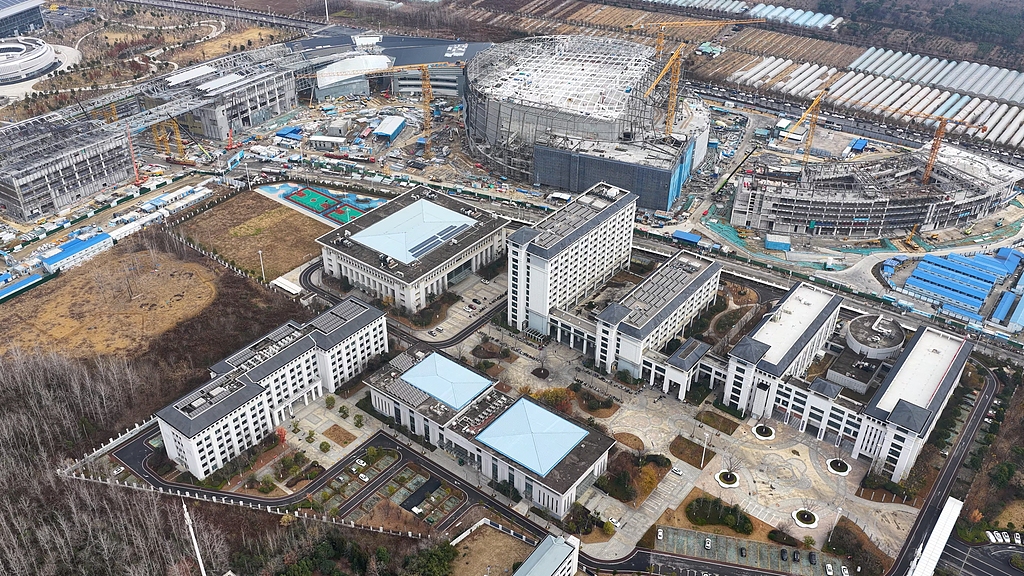
The "artificial sun" experiment was conducted in Hefei, China./ VCG

Researchers have identified a method to surpass the plasma density limit in experiments with the Experimental Advanced Superconducting Tokamak (EAST), known as the "artificial sun," providing a crucial physical basis for high-density operation in magnetic confinement fusion devices.

This research was conducted collaboratively by the institute of plasma physics at the Hefei Institutes of Physical Science under the Chinese Academy of Sciences, Huazhong University of Science and Technology, and Aix-Marseille University in France, among other institutions. The findings were published in the journal Science Advances on Friday.

A tokamak is a toroidal device that employs magnetic confinement to achieve controlled nuclear fusion. It resembles a helical "magnetic racetrack," effectively confining high-temperature plasma to promote fusion reactions. Plasma density, a crucial parameter affecting tokamak performance, directly impacts the rate of fusion reactions.

Historically, researchers have acknowledged that plasma density has an upper limit. When this limit is reached, the plasma becomes unstable, escapes magnetic confinement, and releases substantial energy onto the device's inner walls, thereby jeopardizing operational safety.

While long-term international fusion research has indicated that the physical processes triggering the density limit occur at the plasma-wall boundary region, the underlying mechanisms have remained unclear.

In this study, the Chinese research team developed a self-organized plasma-wall interaction theoretical model. Through this model, they identified the critical role of radiation instability induced by boundary impurities in triggering the density limit, thereby elucidating the underlying mechanism.

Building on this theoretical insight, researchers experimentally controlled the plasma to exceed the density limit and successfully guided it into a new "density-free zone."

These results mark the first experimental confirmation of such a zone in tokamaks. This innovative work not only provides key insights into understanding the density limit but also establishes an important physical basis for high-density operation in tokamaks, according to the scientists.


Source(s): Xinhua News Agency

Original Text (This is the original text for your reference.)

The

The "artificial sun" experiment was conducted in Hefei, China./ VCG

Researchers have identified a method to surpass the plasma density limit in experiments with the Experimental Advanced Superconducting Tokamak (EAST), known as the "artificial sun," providing a crucial physical basis for high-density operation in magnetic confinement fusion devices.

This research was conducted collaboratively by the institute of plasma physics at the Hefei Institutes of Physical Science under the Chinese Academy of Sciences, Huazhong University of Science and Technology, and Aix-Marseille University in France, among other institutions. The findings were published in the journal Science Advances on Friday.

A tokamak is a toroidal device that employs magnetic confinement to achieve controlled nuclear fusion. It resembles a helical "magnetic racetrack," effectively confining high-temperature plasma to promote fusion reactions. Plasma density, a crucial parameter affecting tokamak performance, directly impacts the rate of fusion reactions.

Historically, researchers have acknowledged that plasma density has an upper limit. When this limit is reached, the plasma becomes unstable, escapes magnetic confinement, and releases substantial energy onto the device's inner walls, thereby jeopardizing operational safety.

While long-term international fusion research has indicated that the physical processes triggering the density limit occur at the plasma-wall boundary region, the underlying mechanisms have remained unclear.

In this study, the Chinese research team developed a self-organized plasma-wall interaction theoretical model. Through this model, they identified the critical role of radiation instability induced by boundary impurities in triggering the density limit, thereby elucidating the underlying mechanism.

Building on this theoretical insight, researchers experimentally controlled the plasma to exceed the density limit and successfully guided it into a new "density-free zone."

These results mark the first experimental confirmation of such a zone in tokamaks. This innovative work not only provides key insights into understanding the density limit but also establishes an important physical basis for high-density operation in tokamaks, according to the scientists.

Source(s): Xinhua News Agency
Comments

    Something to say?

    Login or Sign up for free

    Disclaimer: The translated content is provided by third-party translation service providers, and IKCEST shall not assume any responsibility for the accuracy and legality of the content.
    Translate engine
    Article's language
    English
    中文
    Pусск
    Français
    Español
    العربية
    Português
    Kikongo
    Dutch
    kiswahili
    هَوُسَ
    IsiZulu
    Action
    Related

    Report

    Select your report category *


    Reason *


    By pressing send, your feedback will be used to improve IKCEST. Your privacy will be protected.

    Submit
    Cancel